The following quote is widely attributed to Joseph Goebbels, the Nazi Minister of Propaganda.
“If you tell a lie big enough and keep repeating it, people will eventually come to believe it. The lie can be maintained only for such time as the State can shield the people from the political, economic and/or military consequences of the lie. It thus becomes vitally important for the State to use all of its powers to repress dissent, for the truth is the mortal enemy of the lie, and thus by extension, the truth is the greatest enemy of the State.”
But did he really say this? Randall Bytwerk, a university professor whose field of study is German propganda, doesn’t think so. He looked for it in the original sources, and couldn’t find it.
The quote came to my attention today because of this article by David Malone, author of a book called The Debt Generation about the financial crisis. In his article, Malone deconstructs a recent use of the quote by Michael Howard, the former leader of the Conservative Party in Britain. In a speech, Howard cites the first two lines of the quote to justify an occasional lie by the government to maintain economic or social stability. What prevents the government from abusing its power, Howard claims, can be found in the second line of the quote: a lie works “only for such time as the State can shield the people” from its consequences. Innocent, short-term lies may be thus acceptable, even necessary, so long as they are in the public interest.
Malone refutes Howard by bringing in the third line of the quote, which Howard ignores in his speech. To shield the people indefinitely from the consequences of a lie, the quote says, the State must “use all its powers to repress dissent, for the truth is the mortal enemy of the lie.” This means there is no check on State power, as Howard claims, because the State will never be held accountable for the consequences of its lies. Indeed, Malone says, in modern times the State no longer needs to repress dissent at all, but simply “drown it out. Media outlets…owned by a few powerful and like-minded friends” define public opinion today, and dissenting voices are never heard.
The meta-level to all this is that we’re arguing about a quote which, itself, is very likely fabricated. The power of the quote comes from the idea that it’s Goebbels who said it — but Bytwerk, in his research, failed to find an original German source. So if Goebbels isn’t the author of the quote, then who is? And how does that change our sense of the quote’s meaning, or its value in any debate?
My own interest in the quote, and the reason I researched it further, comes from a fascination with its final phrase: “Truth is the greatest enemy of the State.” This phrase isn’t emphasized by Malone, and it is ignored entirely by Howard. But what sort of vision of the State did the Nazis have, I wondered, if they saw truth as its greatest enemy? It must have been a deeply nihilistic vision, because Goebbels seems to be arguing (if, indeed, he really said it) that lies are vital to the functioning of the State — that lying, and thus repression, are the very nature of State power. This certainly fits with what we think of the Nazis, but it’s troubling to those of us who believe that power comes from the people, and is only delegated by the people to the State. I wanted to learn more about the quote’s context — what speech did it come from? what did Goebbels say before and after? — but discovered that, on the Internet at least, there is no context. It’s a free-floating quote, nothing more.
So, the Big Lie Quote is itself a Big Lie? And the Nazis never claimed that truth is the enemy of the State? Yet many people today — perhaps even the majority! — seem convinced that State power can sustain itself only through secrets and lies, which are the subject (and the title) of Malone’s article. Indeed, we’ve gotten new proof that our paranoia is justified, in the form of revelations that our private phone and Internet communications are being sucked into vast databases by the surveillance arm of the U.S. government, to be stored, perhaps forever, on servers buried deep in the Utah mountains. (Does this surprise anyone? I thought it was already an open secret!) The degree of fraud and insider dealing, and the lack of subsequent prosecution, in the 2008 financial crisis — or among defense contractors in the Iraq War — are further grounds for a deep and abiding cynicism in our government. The fact that the election of a supposedly progressive president has only strengthened the security state and pushed its secrets deeper underground is the final, ironic twist. It’s over, Joe! No matter how you squirm, the net will tighten.
So is truth really the enemy of the State, whether Goebbels said so or not? If it is, then the State must have nefarious interests of its own, opposed to those of its people. But can’t we imagine, instead, a State dedicated to spreading truth, because truth helps to serve the people’s interests? I refuse to believe that State power, as such, is incompatible with transparency and truth. To say that is to accept that democracy is always and forever a sham. That can’t be! The trouble is that we’ve too easily come to accept a cynical vision of the “necessities” of power, and we’ve got to stop living in that paranoid, nihilistic world. So how do we get from here, to the world as it should be — a world where everyone can see and debate the truth? What steps should we take? What is the first step?
I began eatbees blog at the end of 2006, after returning to the U.S. from three years in Morocco. At the time, since I had friends in both places, I felt that I might be able to serve as a bridge between the two cultures, “Western” and “Arab-Islamic,” that were too often (and still are) portrayed as incompatible or even at war. I wanted my friends in the U.S. to know that Arab and Muslim youth aspire to democracy, personal dignity, freedom of thought and self-expression just as we do. Equally important, I wanted my friends back in Morocco to keep the faith that despite outward appearances (these were the worst of the Bush years) we in the West hadn’t abandoned these ideals.
I wanted my blog to show that conversation was possible, something I knew from the many rich discussions I’d had about politics, religion, and culture during my time in Morocco. It was an experiment, and during its heyday, 2007–2009, it proved to be a great success. Thanks to the many new friends I made as a blogger, often young Moroccans (or Tunisians, Egyptians, Syrians, Iranians…) who were blogging themselves, we tackled subjects like whether Islam can act as a progressive and democratic force, whether traditional identity is compatible with modern ideas of individual rights, and how (even then, four years before the Arab Spring) internet activism can enable young people to engage in critical thinking and challenge the “red lines” of the authoritarian state. I deeply appreciate the exchanges we had then, in which a community formed that supported and enriched each others’ efforts. Quite often, a theme raised on one blog would be taken up and expanded on other blogs in a web of interconnected commentary and debate. Many of the people I met then, online, ended up becoming friends in the real world when I returned to Morocco in 2009. But for all its richness, that era died out — and since those days, I’ve struggled to feel the same motivation for blogging I felt then.
One thing that happened is that many of my friends from that era simply stopped blogging, and they’ve stopped coming here to comment on new pieces I write. Their blogs are either updated so rarely as to have gone into a coma, or they’ve disappeared altogether. Of course, I’m as responsible for this failure as anyone, as a glance at my archives will show — my blogging has slowed dramatically in the past three or four years. Another problem, which isn’t really a problem at all, is that events have caught up with us, and leaped beyond us. Instead of merely speculating about the possibility of change in the Arab world, now we are living it, with upheavals in many countries that are far more dramatic than anything we could have imagined in 2007. Journalists also cover the Arab world very differently today. It’s no longer just about the way the Middle East impacts the security of Western states (though it’s still too much about that) — the media have finally figured out that history can be made in the Arab world, by and for Arabs, just like in Latin America, Asia, or anywhere else. So what we were trying to do as bloggers is maybe less necessary now. People no longer need to be persuaded of what we were saying, because those who went into the streets took it out of our hands. Certainly it’s out of my hands as a Western observer — and in the hands of Egyptians, Tunisians, Libyans, Syrians, and all the rest.
Another point I want to make is that as a blogger, at a certain point one has to make a decision. Either one is going to “turn pro,” become an “authority,” or keep doing what one is doing as a purely personal venture. Nearly all of the bloggers I follow regularly now are the ones who’ve gone pro. Either they are working journalists who keep blogs as part of their work, or they are academics who follow social, political, and economic trends regularly and in depth. A few are activists who’ve made a name for themselves, and made the leap to being full-time policy voices. I might, at some point, have had my own chance to “turn pro” — but if there’s anything I’ve been consistent about throughout my life, it’s that I’m not an expert on anything — especially not a place as rich and complex as Morocco, where I wasn’t born and raised, and don’t have any kind of special insider knowledge. As a teenager I used to hate “experts” who set themselves up to talk about the very things they know least about. In the field of Arab or Islamic culture, such people are called Orientalists — and I’m damned if I’m going to Orientalize my time in Morocco, because Morocco is not my sphere of expertise, it’s my everyday life, and these are my friends. So, paradoxically, since returning to Fez in 2009, I’ve found it harder to talk about Morocco than when I was away, because it’s too real, too intimate, and too mundane. If I see kids with smart phones in the local café, does that mean there’s an “emerging Moroccan middle class”? If I see a street protest, does that mean “Moroccans are losing their fear”? I’ll leave that to the objectifiers, the specialists, the “experts” real and imagined. This blog will have to remain personal, if it is to continue to exist at all.
That said, I apologize for not writing here more often in recent times. I realize I still have friends who come here occasionally to learn what I’m up to, or to discover my thoughts on this or that — and they’re bound to be disappointed if, as is the case now, I haven’t authored a new post in several weeks. For this, I have several excuses. In our era of instant communication, where the world’s news stories are updated online from minute to minute, there are times when I get so caught up in chasing all the latest developments, and examining the new leads, that I have no time left over to write about what I’m reading. Besides, there are others who do that for a living, so if my readers really wanted that information, they could get it for themselves in the same way I do. I’m thinking about events like the new Egyptian constitution that was approved last year in an atmosphere of extreme political tension, or the controversy around the selection of Chuck Hagel as U.S. Secretary of Defense, or the recent elections in Israel and Italy, or the selection of a new Pope, or the Boston Marathon bombing and subsequent hunt for the suspects. When, in the past, I’ve tried to comment on events like these as they happen, I’m often embarassed by what I write just a few days later, because by then the rush of events has made my initial reaction look foolish and incomplete. Perhaps in the future I’ll just throw up a few links to whatever stories I’m reading at the moment, as I’ve seen other bloggers do, without even a word of commentary, and let you, my readers, follow them if you like. It pains me to do this, because I like to explain what I’m thinking, but in this busy world, who has time to stop and explain?
Besides the difficulty of keeping up with events, there are other reasons why I don’t update my blog more often. One is that, obviously, I have a personal life that takes priority. If someone close to me is experiencing pain and difficulty, that takes a toll on me that makes it hard to focus on blogging until the situation is resolved. In a similar vein, if there is happiness around me, my instinct is to jump in and live the moment, rather than set that aside for an abstract pleasure like blogging. Beyond that, I’ve found that I can’t always vent my feelings, be they good or bad, in a public place like this, because they involve other people who may cherish their privacy. So I edit out a good deal when I write here, and I don’t like to do that, because I’m a fairly transparent person by nature. The result is that I stick to abstract subjects like politics that don’t touch me directly, which gives an incomplete picture of what really matters to me. What I care about most are people — people as unique individuals — and this blog began as an effort to reach out to people in new ways. Yet paradoxically, blogging takes me away from the people I care about, or they take me away from the blog. I still haven’t found the right balance between self-exposure, which makes writing real, and the abstraction needed to make what I say matter in a lasting, universal way. Occasionally I feel like I’ve hit the right balance — as in In or Out? which explores my conflicting impulses toward engagement or isolation, or Women: Parasites or Saviors? which asks where misogyny comes from — and these are among my most popular posts. I’d love to do more of this kind of writing, but all I can say is, I’ll try. The flash of inspiration doesn’t always come when I need it, nor do I always have the time.
So where do we go next? For a while, I was thinking of wiping the slate clean. I would take all my old articles offline, and start over with a new look and new themes. The focus would no longer be on current events, but rather on culture and history. Perhaps I would talk about the books that I’m reading, like Paul Bowles’ The Spider’s House, or Khalil and Dimna, a fable from ancient India, or Utopia by Ahmed Tawfik, a nihilist’s view of near-future Egypt. I would talk about the films that I’ve seen lately that interest me, whether old (Heaven’s Gate, Letters from Iwo Jima, The Battle of Algiers) or new (Enter the Void, Road to Nowhere, We Need to Talk About Kevin, Headless Woman). I would talk about the relation between psychology and propaganda, as related in the documentary Century of the Self. I would mention the music I’m listening to, from Carlos Gardel to Fela Kuti to Joy Division, and the trips that I’ve taken, to the Dades Gorge in southern Morocco, or to the Mani Peninsula in Greece. I might throw in a few photos, along with descriptions of where they were taken and what they mean to me. I might even offer some poetry and short fiction. I would describe the researches I’ve done on the reign of Edward II of England, or the White Lotus movement in Yuan dynasty China. (Just recently, a friend asked me if Voltaire had provided “elite justifications” for slavery, and I researched that too, finding to my shock that it’s more true than you might think.) I would write posts that start from nowhere and go nowhere, and expose thoughts that to an outsider must seem arbitrary, chaotic, and fleeting. Above all, eatbees blog would avoid the news of the day, and instead offer a glimpse of my broader enthusiasms, however whimsical and opaque. The blog would take on a new identity, and become something entirely different from what it’s been until now.
On reflection, I decided that I can do all that without wiping the previous blog from existence. It’s one thing to make a fresh start, but I owe it to those who commented here in the old days to keep a record of what we did then. Many of those articles still attract readers, either because they are linked from other sites, or because people find them in web searches. Besides, even if I start anew, there’s no guarantee, despite my best intentions, that I’ll update the blog any more often than I have in the recent past. I’ll still be just as busy as I am now, and as easily distracted — and writing will be just as much work. Better to have a solid foundation, then, of past articles, than start over from zero. If I did wipe the blog clean, the site might remain empty for a long time! If I leave the past work in place, however, and keep plugging away, then over time the tone of the blog will change naturally on its own, and people will see that change for themselves. No reason to get too dramatic about it.
I do want to express here, however, my intention to do something different, and strike off in a new direction. And in this, I hope you will help me. First of all, we have to return to the days when comments were frequent, and the commenters (you) talked to each other. So if you’re out there, even if you’re not the sort of person who normally comments on blogs, please take the time to leave a comment on this post. Maybe you just want to say hi! Maybe you want to give me a push to post here more often — and in that case, the best way to do that is to tell me what you want to hear. Do you want pictures of mountain goats? My poetry translated into Arabic? A list of my favorite rap songs? Stories of paranoia and drug addiction in Reagan’s America? Shocking images of babies thrown from towers into the jaws of crocodiles? An examination of Brahman and Atman and how this relates to Gnostic Christianity? A discussion of dark matter? Links to articles about Fernando Pessoa? Whatever it is, just tell me, and that will be our starting point. Don’t worry, I’m not desperate — I’ll only follow your suggestions if they make sense to me. I already have a life, and I don’t need whatever attention this blog brings. But I do enjoy a good conversation, and I’m curious about you, so I’m leaving the door open to see who walks in. Leave a note!
When I met last week with two Moroccan friends whom I hadn’t seen in a while, the first thing each of them wanted to talk about (the meetings were separate) was the anti-Mohammed hate film and the controversy it has caused. Both of them were upset, but they are worldly types who know that YouTube is filled with all kinds of trash, so they weren’t thrown into a frenzy by the simple fact that such a film could exist. They know they are haters out there. What they did want to know was how the U.S. government could stand by and do nothing, when the film was clearly designed to insult a whole community of innocent people (Muslim believers), and stir up trouble. Especially once the embassies were attacked and four Americans killed, wasn’t it the government’s obligation to shut the film down — if only to protect their own interests, not to mention prevent further offense? And didn’t their refusal to do so represent some kind of endorsement?
My response was, first of all, to point out that the filmmakers are a bunch of losers, completely unknown before the film went viral and had its stunning “success.” It is beyond the capacities of even the U.S. government to watch every video on YouTube, and estimate the potential for future harm before it happens. My friends were doubtful about this, perhaps because they give too much credit to the power and reach of the U.S. government, and perhaps because they live in a state that keeps a watchful eye on everything its citizens are doing and thinking. But I explained that our government has far more important things to worry about than fringe dwellers on YouTube. They are engaged in wars, overt and covert, in several nations, and are trying to figure out if Iran is preparing a nuclear bomb. They are trying to manage a financial crisis at home, and deal with the consequences of its bastard stepchild in Europe. There is the Chinese leadership transition to think about, and so on. Do they really have the time to notice a video on YouTube which, until the events of last week, only a few thousand people had seen?
My friends accepted this logic, though they still had their doubts. They began to look around for a conspiracy, and insist that there was more to this than met the eye. Surely Nakoula Basseley Nakoula, Steve Klein, and the others hadn’t made this film on their own. Someone had put them up to it — perhaps the Syrians, perhaps the Israelis, perhaps even the U.S. government itself. I mentioned Occam’s Razor, the idea that when trying to decide why something happened, the explanation “that makes the fewest assumptions” is often the best. Sometimes, I said, Oswald really is the lone gunner, the planes that flew into the World Trade Center are the cause of its collapse, and a hate film made by a bunch of nobodies is able to provoke rage in twenty countries. To imagine otherwise is to believe not only that the conspirators can forsee the results of their actions with eerie precision, but that they are able to control everything down to the smallest detail to get the intended result. Sometimes, I insisted, stuff happens — things no one saw coming, that create the illusion of a malign genius pulling the strings.
This left one other question on the table. Once the damage done by the film became known, why did the U.S. government continue to defend its right to exist? Why didn’t they just pull it off the internet, and arrest the filmmakers? This may seem like an outrageous question to many Americans, who put the blame squarely on the shoulders of the mobs who resorted to violence. For an American, a verbal assault never justifies violence — they are two different things, and a person who leaps from one to the other is displaying a moral weakness, a dangerous lack of self-control. (We can argue whether this is really true. What about bar fights? But we do tend to blame the person who threw the first punch, not the first slur.) My friends, who come from a different culture, see things from a different angle. For them, social harmony is more important, and freedom of speech is never the right to insult and defame. They see nothing wrong with expecting people to dress modestly, avoid vulgar language, and keep their carousing out of sight. After all, your grandmother might be offended — it’s a simple question of respect. Even more so for a film whose sole purpose is to offend others. Isn’t that like dumping your garbage on someone’s lawn? What right does that have to be protected speech?
I explained what free speech means in America. Different societies have different standards, I said, and the U.S. has perhaps the broadest standard of all. The only red lines I’m aware of are direct calls to violence, or spreading false information (such as slander or fraud) that does material harm. Even then, a crime must be proven, with evidence of intent and according to law. There is simply no way to remove a film proactively from circulation, on the simple assumption that someone’s feelings might be hurt. So there is nothing illegal about the Mohammed film, no matter how disgusting we may find it — and there’s a reason for that. America was settled by people fleeing from religious or political persecution, and they placed a very high value on the freedom to express their beliefs. In fact, this is the core value on which all our other freedoms are based. To protect that right, we must extend it to everyone. This means that no matter how strange or offensive an opinion may be to the rest of us, we protect it in order to protect our own perhaps equally bizarre opinions. And we accept the consequences of this, namely that we can never expect the government to step in and tell someone he’s wrong. If we find an opinion harmful we need to defeat it in argument, not through the force of the state — or just learn to “live and let live.”
Of course, as I think any American understands, this is the ideal, but the reality is far from perfect. These protections weren’t extended to Communists in the 1950s, who were considered to be agents of an enemy power. Another example is the Jehovah’s Witnesses, who were persecuted in the 1940s for refusing military service on religious grounds. Joseph Smith, the Mormon prophet, was martyred in 1844, and from the Wobblies to the Civil Rights movement to the Occupy movement today, the U.S. government has a history of spying on opposition movements. Perhaps to a greater extent than we realize, we pick and choose which opinions to tolerate, which to celebrate, and which to suppress or condemn. The idea of freedom of speech as an incontrovertible right plays a fundamential role in our self-image as Americans, but in practice, we do place limits in the name of protecting ourselves against a greater danger. So the question remains — why is the Mohammed film okay, particularly when it has placed our relations with a large part of the world at risk? Is it possible that this is a symptom of something deeper in the American psyche? Is it possible that hate speech against Muslims is something we are prepared to defend, more so than other forms of hate speech?
Keep in mind, this film didn’t appear in a vacuum. Now, this isn’t the same as saying that the film was made by hidden conspirators, or anyone other than the handful of losers whose names we know. But there does exist an international network of anti-Muslim hate groups, from the English Defence League to Geert Wilders in the Netherlands to people like Anders Behring Brevik, the Norweigian mass murderer, that has strong roots in the U.S. as well. Bloggers like Robert Spencer and Pamela Geller are the “intellectual” leaders of this movement, with Geller currently running ads on buses and subways in American cities that refer to Muslims as “savages.” Politicians like Newt Gingrich, Michelle Bachman, and Peter King have lent their support to this movement as well. Mosques have been burned, referendums have been passed against the nonexistent threat of Sharia law, and an attempt to build a Muslim cultural center in lower Manhattan drew national controversy before it was finally approved. Our own president is often accused of being a Muslim — as if that were the deepest insult, a fatal sign of his “otherness.” Fortunately none of these are majority views. But it does show a certain tolerance for anti-Muslim hate speech, a double standard that calls into question our claim to universal rights.
In defending the right to make a film insulting Mohammed, are we merely sticking up for our principles? Or are we picking and choosing? If a group of Hezbollah supporters living in the U.S. were to make a film portraying Jews as pederasts, money-grubbers, and depraved lunatics — which is how Mohammed was portrayed — would our first instinct be to champion their right to free speech? Or would outrage and condemnation rain down from all sides, along with calls to investigate their finances, their network of connections, and even kick them out of the country? Perhaps the viewpoint of my Moroccan friends, which places social harmony first and asks people to use their rights responsibly, is worth hearing. Of course, it’s never okay to storm an embassy by scaling the walls, setting fires, sacking and pillaging. But that shouldn’t obscure the fact that millions of people who didn’t do these things — engineers, grandmothers, shopkeepers, schoolchildren — were deeply hurt and offended. Is our message to them that we don’t care, because they’re Muslims and somehow deserve it? Or can we show some respect? If they were our neighbors — which in this world of YouTube and Twitter, we all are — would we toss our garbage on their lawn, or would we strive to be neighborly?
It feels silly to appeal to basic decency, because that’s such an unhip value. It feels silly to say, “Muslims are people too,” but they are. Perhaps the rush of claims and counterclaims in the media makes us lose track of that fact. Muslims aren’t some abstract group of “others.” They get up in the morning and have breakfast, kiss the kids and send them to school, get on the bus to go to work, sell shoes or chop meat or fill out paperwork, study hard because they want to pass the test, have illicit affairs, go drinking with their pals, fall asleep in front of the TV. What are we trying to say to these people, when we claim that it is an American value to insult their religion, their cherished beliefs, and the bonds that tie them together? I support the right of Nakoula Basseley Nakoula to make that film — it’s our principle of free speech. But I think there’s a conversation we should be having as Americans, as to whether it’s the right thing to do. After all, we value social harmony as much as Muslims do. We voluntarily place limits on our own freedom. We don’t think it’s okay to walk up to people on the street and start hurling insults — so why do it on YouTube? It may be legal, and it may be protected speech, but a person obesessed with insulting others is not very healthy. Perhaps we should shame them in the same way we shame anti-Black racists, or anti-Semites. If Muslims are the last group in the world whom it’s okay for Americans to insult, that doesn’t reflect very well on us as a culture.
“I’m really glad he decided to capitalize on this, rather than let other people produce shirts and other merchandise. Remember, beneath the outrageous interview is a guy who ran into his sister’s bedroom to stop a rape — he deserves all the good fortune he can get.”
“I’m really starting to get mad because everyone is out for money and don’t care about whats really going on. I’m not going to play this funny role anymore. I really haven’t foreal. Realize that my goal is to be a business man not a joke and… lately people been taking me there. That is not who I am. Understand that I was just mad and wanted justice for my sister. It wasn’t made to be funny. Although I thought it was funny but all jokes are aside now. People are really sweeping this under the rug. I hope that this man will be caught. You don’t know how this changed our life. So I guess it’s funny that we are moving from house to house too. I guess it’s funny my little sisters are scared t death to sleep at night. I guess it’s funny that he may climb in someone else’s window. This is not a game so don’t take it there.”
“There is nothing wrong with Antoine. Or his story. Or how he chose to express himself. Kelly [Antoine’s sister] and Antoine were very clear… they live in the projects. They are also Southern… they live in Huntsville, Alabama. And they both had a right to be exceptionally angry about Kelly’s attempted rape. Yet, even in their rage, they exhibited more intelligence and articulated a sense of well-being than many of the persons who have been elected or otherwise appointed (and some self-appointed) to represent us.
“Embarrassed by Antoine?! Please. We should be thankful he’s here. He may just force us to redefine our priorities and how we think we understand one another.
“Antoine Dodson’s character seems to be better than most.”
She goes on to remind us of how this all started. This is the story of a poor family living in public housing that failed to keep them safe. They reached out to the authorities in the aftermath of an attempted rape and were not taken seriously — so they got mad. This inspired her to write a letter to the Huntsville, Alabama authorities on their behalf, and she provides contact information on her blog for anyone else who wishes to “hold these people accountable.”
UPDATE 2: It occurs to me that the reason this young man’s cri de coeur touched a chord with so many of us — “Y’all need to hide your kids, hide your wife, and hide your husband, ‘cuz they’re rapin’ everybody out here” — is because it reflects the unease we all feel in these troubled times. Don’t we all somehow feel under assault after a decade of economic crisis and war, with no end in sight? As Antoine said in a radio interview about all the newfound attention his family is getting:
“We’re not used to this, you know what I’m sayin’? Like, everybody steps on us, you know what I’m sayin’? People degrade us, so it’s like… all this love that the world has been showing us lately, is like, ‘Man, this is so amazing,’ and every time I get a chance with my sister, we cry about it, ‘cuz it’s so amazing, like, ‘Wow, two and a half weeks ago, nobody cared.'”
So doesn’t this young man speak for all of us, and our sense of powerlessness in some way? Haven’t we all wondered how this could possibly be happening, how there could be millions out of work and at risk of losing their homes, how communities could be closing their libraries and shutting off streetlights for lack of funds — yet the government, under a new president and a new party, still seems powerless to end the disasterous policies that brought us here? Antoine at least did something. He stopped a rapist, he protected his family, and he spoke up as we’d all like to do. So in this, the more I think about it, he is a hero — an accidental hero, the best kind.
We live today in a society where it is necessary to see yourself, or your likeness, in the media as confirmation of your existence. People scan the television dial, major magazines, movies, or the latest pop novel to find someone who resembles them, someone who is out there mimicking their actions and gestures in the big arena. … Lest we forget, this whole scenario is market driven, and if your image does not appear en grand across the whole media superstructure of America, it is because the marketing mechanism has not deemed your niche to be worthy of selective attention, and thus—O humiliating failure!—there is nothing out there for you to buy. Which is to say, You don’t exist, go die. … You have no identity, you are invisible. You don’t even need to be “disappeared” because you are already not there.
This was written back in 1994, so it took the New York Times just sixteen years to catch up. Though I will give them credit for distilling the idea to its purest form.
“Our movement is secular and our members come from very diverse backgrounds. Atheists, socialists, Amazigh, secular… everyone is represented in our association. We are above all free and we operate in a democratic manner. …
“We cannot insult religions. Whether it’s Muslim, Jewish, Christian or otherwise. Within our association, we are able to differentiate between criticisms and insults. We of course encourage criticism, but we neither insult people nor what is sacred. Regarding homosexuals, I have backed some in the past. I have no problem with that. I think they have every right to express themselves, to run a blog or a website. … This is to tell you that we respect everyone and remain open to all trends.”
“This initiative comes from the very top. Jamal Eddine Naji, the coordinator, is a close friend of the King. He was commissioned by the ruling party, Authenticity and Modernity Party, to impose the state agenda without taking the opinion of journalists into account. …
“If it is a dialogue, it is being done without the real actors of the electronic media. They instead want to keep the press at bay, impose their rules, impose electronic censorship and muzzle it. I personally received an official invitation. I attended two of their meetings, once as a representative of the association of bloggers and another as a journalist. But once they realized that we were serious, that our proposals were credible, they discredited us by calling us fundamentalists to silence us. So we steered clear.”
Regarding the climate of blogging in Morocco generally:
“We live in a constant state of arrests and releases. … It is true that there are no laws that regulate the blogosphere to guarantee the right to free expression. However, what the authorities are looking for is a way to censor blogs. They have the means to put pressure on the media — through printing presses, distribution agencies, etc. — but blogs are difficult to censor. That is why the authorities are severe with bloggers.”
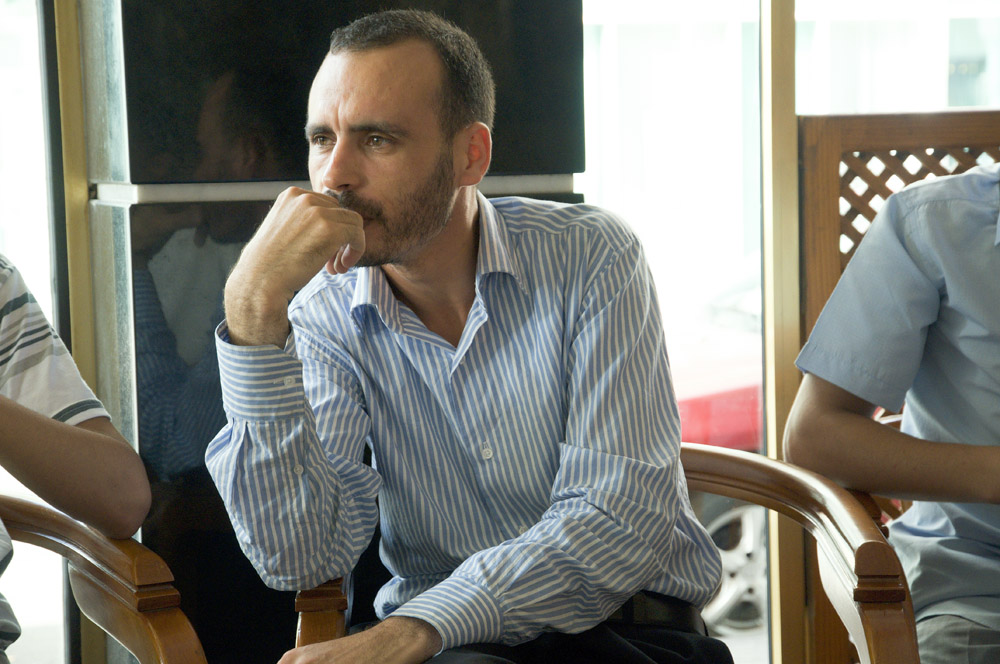
I met Said Benjebli last summer, when by coincidence I was in Casablanca on the same night as a meeting of the Association of Moroccan Bloggers. I attended by invitation from blogger Mounir Bensalah, and the photo above is from that occasion.
I have a few questions. They aren’t rhetorical questions, these are things I’m genuinely not sure about.
Granted that 2009 wasn’t a great year for freedom of expression in Morocco. I could list the cases here, but others have done that. Said Benjebli isn’t alone in fearing that the Moroccan authorities are turning away from their earlier promise of greater freedoms. But is it possible that the recent wave of criminal prosecutions is, paradoxically, a result of those greater freedoms? Perhaps they are growing pains as journalists and bloggers test the limits, and the state struggles to define its new boundaries?
Should a bloggers’ association be focused primarily on defending the rights of bloggers who test the limits, or does it have a broader constituency? I would certainly want such a group backing me if I were a Moroccan blogger who unknowingly ran afoul of the famous red lines. On the other hand, I can’t help feeling that there are infinite creative ways to express ourselves, without directly taking on the state in areas where it feels most insecure. Technology, education, history, the arts, the economy, philosophy, social science, and religion are all domains of self-expression that aren’t necessarily political. By defining bloggers as journalist-activists who test the political limits, is the association scaring away, rather than promoting, other worthy forms of self-expression?
What are the right limits on freedom of expression? Surely we’ll agree that no right is absolute. Even in the U.S., a phone call to a Congresswoman threatening to torch her house, or an active-duty soldier calling on his fellows to disobey the president’s orders, will earn the attention of the authorities. Those may be extreme cases, but where do we draw the line? The Moroccan state has the right, even the duty, to protect its territorial security and social stability. If certain forms of expression are seen as a threat, it can pass laws to restrict them. We may disagree with those laws, as I have in the past, in which case we have two choices — lobby to change them while continuing to obey them, or break them consciously to show they are unjust. The second choice, civil disobedience, involves accepting the penalty as a form of protest. So what are the right limits on freedom of expression in Morocco? Should bloggers be allowed to write literally anything? What should the state do when bloggers go over the line?
As a developing country in a troubled world, Morocco has its share of problems. However, when I look around me, I see a diverse population, a growing economy, and young people with a lively creative imagination. It pains me a bit to see reports of Morocco slipping back into a dark age of heavy-handed repression, because that doesn’t jibe with what I see around me every day. So let’s assume for a moment that Morocco is moving forward, but in a two-steps-forward, one-step-back kind of way. Sometimes we’re made painfully aware of the limits on progress — and yet progress is being made. What is the best way to promote self-expression in such a context? Where will it do the most good?
UPDATE: Hisham of Al Miraat has published an interview on Global Voices with blogger Bashir Hazzam, who was sentenced to four months in prison for blogging about a demonstration in the southern town of Tarhjicht. He was released on Feburary 8, two months after his arrest, partly due to interntional pressure. He explains his views about blogging this way:
“I discovered the world of blogging when I was a student. I came across a number of blogs and realized that blogging enables people to publish their ideas easily, without control and for free. I liked the idea so much that, after a brief research, I ended up creating my own blog…. The blogosphere enabled me to exchange views and ideas and communicate with many bloggers and writers from around the world. … What happened will not affect me. Despite the arbitrary detention, I kept my writing style intact. It will not affect my thoughts or my views. … I would invite people to take advantage of technologies offered by the Internet to highlight their skills and talents, and express their ambitions and aspirations through blogging, so as to break the systematic marginalization imposed by authoritarian states, especially on the youth.”
On December 8, 2009, the U.S. House of Representatives passed, by a vote of 395 to 3, a resolution specifically naming three Arab TV stations — Al Manar, Al Aqsa, and Al Rifadayn — as “terrorist owned and operated” channels that broadcast “incitement to violence against the United States.” The resolution stated that any satellite provider that broadcasts these stations, or others to be named later, would be considered a “Specially Designated Global Terrorist” under the law. The president would be required to report to Congress each year concerning “anti-American incitement to violence” on TV stations across the Middle East, covering 19 nations from Morocco to Iran.
The three “terrorist” stations are carried on the two largest satellite providers in the Middle East, NileSat of Egypt and ArabSat of Saudi Arabia. Between them, NileSat and ArabSat offer hundreds of stations, most of which show cheesy movies, game shows, and cartoons for kids, as well as the official state programming of the various Arab nations. This resolution, known as H.R. 2278, would require NileSat and ArabSat to block any channel the U.S. labels as terrorist, or see themselves labeled as supporters of terrorism. The resolution still needs to be approved by the Senate and signed by the president to become law — it is currently before the Senate Foreign Relations Committee chaired by John Kerry. So there is still time for Washington to come to its senses, but it should be clear that by issuing such a heavy-handed demand for censorship, Congress has sent exactly the wrong message to the Arab world.
Al Manar is the voice of Hezbollah, which besides being an armed resistance movement against Israel, is a political party active in the Lebanese government. Al Aqsa is linked with Hamas, also a resistance movement and the de facto government of the Gaza Strip. Al Rafidayn is an Iraqi station described by the Open Source Center, an arm of the U.S. intelligence community, as a “pro-Sunni, anti-U.S. Iraqi channel believed to be affiliated with the Association of Muslim Scholars.” Of the three, only Al Rifadayn could remotely be accused of “incitement to violence against the United States,” since it supports resistance to the American occupation of Iraq. There is a blurring of lines here between “terrorism” and legitimate resitance — a difference which is in the eye of the beholder. None of these stations supports random acts of violence against civilians, such as suicide bombings or kidnappings, which is the usual definition of terrorism. All provide legitimate news services to the population. And the target of resistance for both Al Manar and Al Aqsa isn’t the U.S. at all, but the state of Israel.
I’ve watched Al Manar here in Morocco, and while they have their share of pro-resistance propaganda — scenes of heroic battles from the 2006 Lebanon War, accompanied by patriotic songs — they are also a news source with high standards of professionalism. In fact, they were the only ones providing on-the-ground coverage during the Israel–Lebanon conflict — even Al Jazeera used their footage — and it was through their station that I became aware of the devastation Israel was raining down on a beleaguered nation. Perhaps that’s what bothers the U.S. Congress. It’s certainly what bothers Israel. Henry Lamb, an American lawyer living in Lebanon, who seems to be the only one writing in depth about H.R. 2278, cites a “Washington DC observer” on the motivations behind the proposed law.
“Regarding Al Manar it’s personal for Israel. The reason is that Al Manar did to the Israeli government propaganda machine during and following the July 2006 war what Hezbollah fighters did to Israeli troops. Al Manar kicked butt. That station must be made to disappear. The plan is to stop the 15-20 million daily viewers of Al Manar from receiving its transmission and well as to intimidate all the other Middle East TV channels that are suspected of moving toward the growing ‘Culture of Resistance’….”
In another article, Lamb praises Al Manar’s “reputation for accuracy, thoroughness and objectivity and getting the latest news on the air fast.” Speaking of the tragic crash of an Ethiopian airliner in Beirut on January 25, he adds:
“As Lebanese woke to the news this morning an estimated 80% of the population is thought to have turned into Al Manar at least once sometime between the hours of 7 am and 11 am, as they and the region regularly do during war or crisis. … Al Manar was the first Lebanese station to give the most details…. Ironically, staff at the American Embassy, and surely the large contingent of CIA agents here, almost certainly sat glued to Al Manar to evaluate what really has happened. [If H.R. 2278 becomes law] US officials may be deprived of this reliable source of information.”
During a recent visit by Senator John McCain, Lebanese president Michel Sleiman asked “that Washington backtrack on its decision to ban certain television channels, including Al Manar,” according to an official statement. Meanwhile Nabih Berri, the speaker of the Lebanese parliament, sent a letter to U.S. Speaker of the House Nancy Pelosi denouncing the proposed law.
“[The bill] harms the principles of freedom of expression and civil rights, and leads to further complication in relations. … This bill represents bypassing to the sovereign national laws of the targeted countries, among them Lebanon which is a free ‘Hyde Park’ for the Lebanese and Arab satellite ‘public opinion’ media channels. … Therefore, the bill issued by your Congress undermines our sovereignty as well as the sovereignty of many countries….”
Lebanon is proud of its diversity of opinion, which is the thread holding society together after a generation of civil strife. The above statements show that Congress, in its hastily considered attempt at censorship, has united the entire Lebanese political class in protest — not just Hezbollah, a political movement the U.S. still labels “terrorist,” but the elected government as well, which Washington supports.
But there is another dimension to the problem, namely the excuse that H.R. 2278 gives to Arab nations with reasons of their own for censoring opposing views. Chief among them are Egypt and Saudi Arabia, which coincidentally or not, are home to NileSat and ArabSat, respectively. Egypt has been ruled by Hosni Mubarak, known as “the Pharaoh,” for 28 years under martial law. Saudi Arabia is the home of Wahhabism and the obscenely rich Saudi royal family. Both have a history of silencing domestic critics, and both are sponsors of an Arab League proposal to monitor TV stations in all its 22 member nations.
The Arab League first discussed a satellite TV charter back in February 2008, but the recent action by Congress has given new momentum to their plans. On January 24, 2010, Arab information ministers met in Cairo to discuss the proposal. According to Reporters Without Borders, the plan would set up an “Office for Arab Satellite Television” to ensure that stations “respect the ethical standards and moral values of Arab society” and “no longer serve as fronts or outlets for ‘terrorist’ organisations.” In a statement, the Paris-based watchdog group warned of the potential for abuse.
“The danger is that this super-police could be used to censor all TV stations that criticise the region’s governments. It could eventually be turned into a formidable weapon against freedom of information.”
Anthony Mills of the International Press Institute issued a similar warning.
“The International Press Institute is wary of efforts to engage in that kind of monitoring particularly given the record of most, if not all, Arab Middle Eastern countries on press freedom. It’s an example of states in the Arab world using the notion of security to in fact monitor and stifle independent reporting.”
The influence of H.R. 2278 can be seen in two of the stations mentioned by Reporters Without Borders as targets of the new plan — Al Aqsa and Al Manar — along with the plan’s emphasis on “terrorism.” However, as Daoud Kuttab shows in a 2008 article, the original motivations have little to do with “terrorism” or “incitement to violence.” Arab governments simply want to shield themselves from an increasingly independent and critical media universe.
“[Arab information ministers] have been gradually losing power to the satellite stations. For some time governments have been resigned to the fact that the rich and elite will have access to alternative information coming from satellite but the poor masses will continue to be spoon fed through the terrestrial stations. But as the prices of satellite dishes have become affordable to the poor masses, and as the satellite stations have cut deeply into the audience of national broadcasts, the alarm bells started to sound and the ministers of information increased their meetings hoping to find a regional solution to this problem. …
“Couched between clauses that prohibit broadcasting obscenity, pornography and scenes encouraging smoking, the charter calls for ‘Abstaining from broadcasting anything that would contradict with or jeopardize Arab solidarity….’ It also calls for ‘abidance by objectivity, honesty and respect of the dignity and national sovereignty of states and their people, and not to insult their leaders or national and religious symbols.’
“The strange notion that politicians are somehow immune from attack, that leaders are not to be insulted or that the satellite broadcasters are obliged not to jeopardize Arab solidarity is nothing short of censorship.”
It’s clear that by taking up the issue just one month after the passage of H.R. 2278, the Arab League is doing its best to defuse to the claims that NileSat and ArabSat are enabling “terrorism.” However, it’s equally clear that they were given an excuse to do what they want to do anyway — rein in stations whose independence is a thorn in their side. One indication is that along with Al Aqsa and Al Manar, Reporters Without Borders names Al Jazeera as a target of the proposed “super-police.” Al Jazeera is the most popular news channel in the Middle East, and the only one with an international reputation for journalistic excellence and independence. They have reporters around the world, even providing excellent coverage of the 2008 American presidential elections. Their investigative reporting is provocative, as are their discussions with public figures and intellectuals. They are an indispensible actor in the move toward greater freedom of expression in the Arab world.
Some in the U.S. seem to have the impression that Al Jazeera is a jihadi station that shows nothing but suicide bombings and tapes from Osama bin Laden. Nothing could be further from the truth, and it is frankly insulting. People in Morocco rely on Al Jazeera to get an independent perspective on what is happening in their own country, and I’m sure the same is true in other Arab nations. This forces the official state channels to compete in a world where they are no longer the sole source of information. This makes them uncomfortable, and forces them to get better if they want to retain credibility. Meanwhile, Al Jazeera has earned its reputation. They aren’t pushing an agenda. They simply provide balance to Western networks like CNN and the BBC by showing what the world looks like from a perspective outside the West. This can be refreshing, even for an American.
Congress did not name Al Jazeera in H.R. 2278, but the Arab League is using the resolution as an excuse to pressure the station. After all, they hold the power. If Al Jazeera were denied access to NileSat and ArabSat, it would vanish from TV screens across the Middle East. This recently happened to another station that annoyed Saudi Arabia, Al Alam of Iran. When Saudi Arabia got involved in a Yemeni civil war that its propaganda blames — falsely — on Iran, it pressured Egypt to kick Al Alam out of the NileSat lineup. Since ArabSat is controlled by Saudi Arabia, there was no problem there. The station went dark across the Arab world, upsetting my friend’s aunt who liked to watch it daily because “it tells the whole truth.” She also likes Al Manar, also for its independence. What business does Congress, none of whose members have ever watched an Arab news channel, have telling my friend’s aunt that she likes “terrorist” TV?
The Arab League is divided on the “super-police” proposal, with Egypt and Saudia Arabia as key sponsors, and Qatar and Lebanon strongly opposed. Al Jazeera is based in Qatar, where it began as a project of Sheikh Hamad bin Khalifa, so Qatar is defending its own interests there. We’ve already seen that the Lebanese political leadership is ready to defend Al Manar on the grounds of national sovereignty. So it comes down to a test of wills between two nations, Qatar and Lebanon, who are pioneers of Arab media diversity, and two others, Saudia Arabia and Egypt, who represent state censorship and control. Guess which side the U.S. Congress is on? And isn’t it ironic that around the same time Hillary Clinton made a big speech defending the “freedom to connect” on the internet, Congress should be demanding that Arab states use their authority to pull independent media off the air?
Middle East expert Marc Lynch has some valuable thoughts on American efforts to use “internet freedom” to promote its foreign policy interests, particularly in Iran.
He compares a speech by Hillary Clinton, “outlining America’s commitment to ‘internet freedom,'” with an article published the same day “by two key Bush administration public diplomacy officials, James Glassman and Michael Doran, calling on the U.S. to use the soft power of the internet to promote regime change in Iran.”
“[For] Glassman and Doran, who both held important public diplomacy positions in the previous administration and have long been enthusiastic advocates of using the internet…the point is not abstract, universal freedoms — it is using those tools against an adversary. They urge the U.S. to use the new media to undermine the Iranian regime and to help the Green Movement by providing moral and educational support….
“Set aside the question of whether these steps would work to undermine the Iranian regime or strengthen the Green Movement…. The key point here is that internet freedom…[is] clearly and unapologetically a weapon to be wielded against the Iranian regime. For better or for worse, most of the world probably assumes that Clinton has the same goal in mind…even if she doesn’t say so. And that’s a major problem if you think about it. When the U.S. says to Iran or to other adversarial regimes that it should respect ‘freedom of internet expression’ or ‘freedom of internet connectivity,’ those regimes will assume that it is really trying to use those as a rhetorical cover for hostile actions. And if Glassman and Doran have their way, they will be right.”
Lynch goes on to describe the “moral hazard” involved if the U.S. is unwilling or unable to look out for those who might take Clinton’s words at face value.
“It’s great to support and encourage internet activists and protestors of all sorts. But such support can lead them to take some very risky, dangerous activities against their brutal governments, perhaps in the expectation that the United States will protect them from the consequences. Will it? If a blogger inspired by Clinton’s speech decides to launch a corruption monitoring website, and is summarily imprisoned and tortured, does the U.S. have any plan in place to protect her?”
While I share Clinton’s hope that “the freedom to connect…can help transform societies,” Lynch shows the danger of looking at the world solely through a prism of American interests. American words and actions have consequences, to real people outside the U.S. If “internet freedom” is treated as an arm of American foreign policy in which activists are used and then abandoned, it will make the U.S. look like a cynical manipulator and a feckless hypocrite. If, however, the commitment is real and for the long term, it will mean supporting the internet’s many voices even when they are saying what America doesn’t want to hear.
Here’s some interesting, depressing comments on the failed economics of delivering high-bandwidth content to the developing world.
Last year, Veoh, a video-sharing site operated from San Diego, decided to block its service from users in Africa, Asia, Latin America and Eastern Europe, citing the dim prospects of making money and the high cost of delivering video there.
“I believe in free, open communications,” Dmitry Shapiro, the company’s chief executive, said. “But these people are so hungry for this content. They sit and they watch and watch and watch. The problem is they are eating up bandwidth, and it’s very difficult to derive revenue from it.”
That’s the problem with you people, you’re just too hungry! Taking food from the rich people’s tables and holding your hands out for more. Now where have I heard that before?
“It’s a problem every Internet company has,” said Michelangelo Volpi, chief executive of Joost, a video site with half its audience outside the United States.
“Whenever you have a lot of user-generated material, your bandwidth gets utilized in Asia, the Middle East, Latin America, where bandwidth is expensive and ad rates are ridiculously low,” Mr. Volpi said. If Web companies “really want to make money, they would shut off all those countries.”
So far, apparently, Veoh is the only company to take this drastic step. But if you wake up one day to find your favorite sites like YouTube or Facebook blocked, don’t blame your local dictator — at least, not yet. Instead, blame capitalism. Or better yet, blame yourselves! You’re downloading content without being good consumers.
When I read things like, “The foundations of capitalism are shattering,” I’m like, “Maybe we need that.” … Because everything is amazing right now, and nobody’s happy. … We live in an amazing, amazing world and it’s wasted on the crappiest generation of spoiled idiots that just don’t care. …
I was on an airplane and there was high-speed internet on the airplane. That’s the newest thing that I know exists. And I’m sitting on the plane and they go, “Open up your laptop, you can go on the internet.” And it’s fast, I’m watching YouTube clips, it’s amazing—I’m in an airplane. And then it breaks down, and they apologize, “The internet’s not working.” And the guy next to me goes, “Pfff! This is bullshit.” Like how quickly the world owes him something he knew existed only ten seconds ago!